The threat facing European security
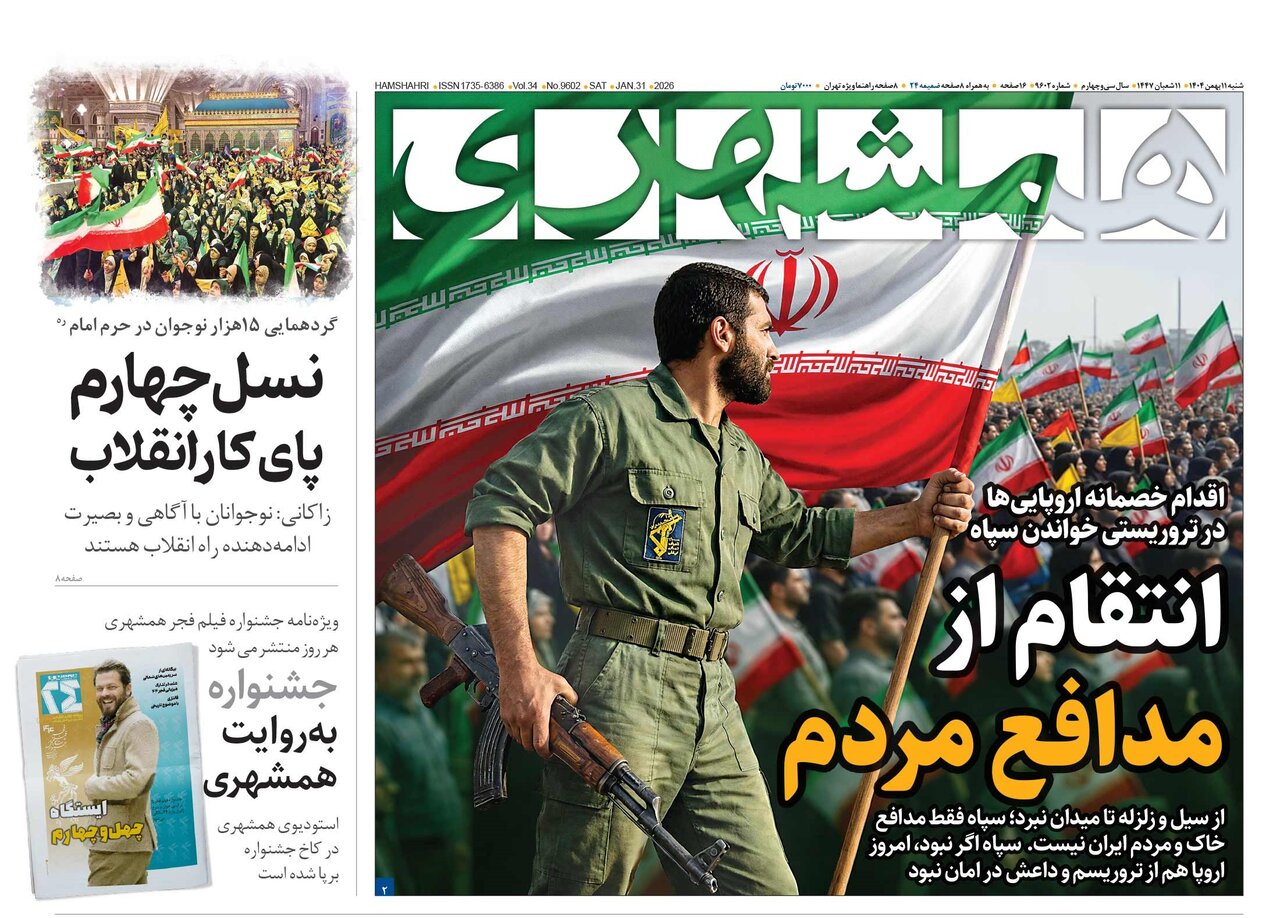
Hamshahri analyzed the European Union’s move to designate Iran’s Islamic Revolution Guard Corps (IRGC) as a terrorist organization. According to the paper, this hostile action by the EU is viewed by experts as a dangerous precedent inspired by Washington and Tel Aviv, and a clear violation of the principles governing international law.
Observers of global affairs describe the EU’s decision to place the IRGC on its so-called ‘terrorist groups list’ as largely symbolic and lacking any practical impact on Iran. They argue that the failed attempt to disarm Hezbollah in Lebanon is a telling example of how ineffective such Western approaches can be. The paper warns that any retaliatory response from Iran to this hostile EU measure would carry serious consequences for European states. The IRGC, which has acted as a major barrier against terrorist networks in recent years, has played a crucial role in preventing terrorist groups from penetrating Europe. The new hostile step, it argues, could expose Europe to growing security threats.
Khorasan: Military threats and their consequences
Khorasan addressed recent rumors and statements regarding a possible military confrontation between Iran and the United States. According to the paper, alongside speculation about renewed negotiations, Donald Trump’s remarks on Friday amounted to a direct and explicit threat against Tehran. Referring to the movement of ‘a massive fleet’ toward Iran, Trump wrote on Truth Social that “hopefully Iran will quickly ‘come to the table’ and negotiate a fair and equitable deal - no nuclear weapons - one that is good for all parties. Time is running out, it is truly of the essence! This explicit threat, combined with references to past military operations and the possibility of future strikes, clearly reflects Washington’s strategy of maximum pressure and its attempt to impose its demands. Iran’s response was firm and unequivocal, declaring that it would raise its defensive readiness to the highest level. This stance underscores Iran’s emphasis on defense readiness and signals to the United States that any attempt to force Iran into accepting unilateral conditions will fail. It also demonstrates that, contrary to some media portrayals, Iran has no intention of surrendering to military pressure and will only consider negotiations if its national rights and interests are guaranteed.
Armane-Melli: What role would Israel play in a potential Iran–U.S. war?
Armane-Melli discussed Israel’s potential role in a possible military confrontation between Iran and the United States in an interview with international affairs analyst Hassan Beheshtipour. According to Beheshtipour, Israel’s political turmoil, its economic challenges, U.S. strategic considerations, and Iran’s own domestic realities all indicate that war is neither likely nor desirable—for any external actor or for Iran itself. Nevertheless, the risk of political exploitation of domestic discontent and the possibility that certain groups may take advantage of heightened tensions remains. Contrary to media narratives, Israel is not in a position to launch a large-scale war. Internal divisions and simultaneous engagements in Gaza, Lebanon, Syria, Yemen, and Iran have imposed unprecedented financial and military burdens on the Israeli government. Under such circumstances, rhetorical threats serve more of a psychological function than an operational one. In the current volatile environment, some hardline factions—by promoting ideas such as a ‘pre-emptive strike’ on Israel—are effectively advancing the interests of Israel and the United States. A pre-emptive attack would not only hand Iran’s adversaries a ready-made justification, but would also alienate Iran’s current partners and draw previously neutral regional states into the conflict.
Javan: A dangerous precedent and a deflection from internal crises
In an article, Javan dealt with the European Union’s recent decision to place Iran’s IRGC on its so-called list of ‘terrorist organizations.’ The paper argues that the move has triggered widespread domestic reactions and serious legal and political criticism. According to the article, the decision lacks any basis in international law or independent expert assessment and represents a clearly biased, provocative, and costly step in the realm of international relations. From the perspective of Iranian public opinion, the measure is not merely an action against a military institution; it is perceived as a direct affront to national sovereignty, collective dignity, and the historical will of the Iranian people. The IRGC is an official and constitutionally recognized institution of the Islamic Republic of Iran. It is regarded as a central pillar of national defense responsible for safeguarding security, territorial integrity, and the country’s strategic interests. Labeling a sovereign state institution as a terrorist constitutes a dangerous precedent in international law and a blatant violation of fundamental principles such as respect for state sovereignty and the prohibition of interference in internal affairs.
Leave a Comment